

A short guide

To buy it or to make it yourself?
For mycelium product developers and mushroom growers, the strategic question is whether to produce mycelium substrate yourself or to outsource it.
The simple answer is: this decision typically depends on your strategic focus and capital. Sourcing your mycelium substrate externally can relieve the burden of the high costs and unpredictability of manufacturing it yourself. It allows you to direct your resources where they are most effective: on your specific production process, marketing, and sales. Ultimately, your final product is what makes you stand out in the market, not the raw material production. While creating demand for mycelium materials requires persistence, there is a way to reduce the uncertainty of entering this field:
- You’re in the process of scaling up producing yourself adds too much cost, unpredictability and troubleshooting
- You have a tight timeline outsourcing prevents production delays by removing the risk of contaminated batches
- Smaller scale projects where buying will just cut the time spent by half
- Prototyping having your base material ready will open up space for creativity and necessary adjustments
- Test runs see if your idea is well received without expensive commitments
- Suppliers are far away increasing transportation costs and carbon footprint
- You need more than 5000L per week justifying setting up a substrate production unit
- You have a proprietary substrate recipe you want to keep secret
- You want to be completely in control of the whole process being able to adjust each and every single variable

We provide Ganoderma substrate for mycelium applications with various recipes and with a very low carbon footprint. If you want to produce substrate yourself, check out our selection of filter bags
Example Projects
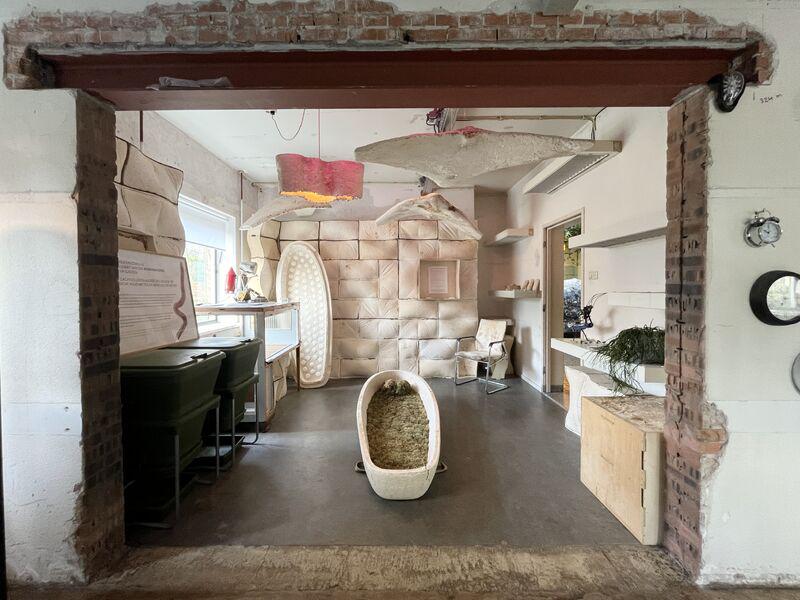
De groene afslag
Conference center De groen afslag in Laren has a special mycelium room where some of the objects from Floriade Worldexpo are shown to the general public.
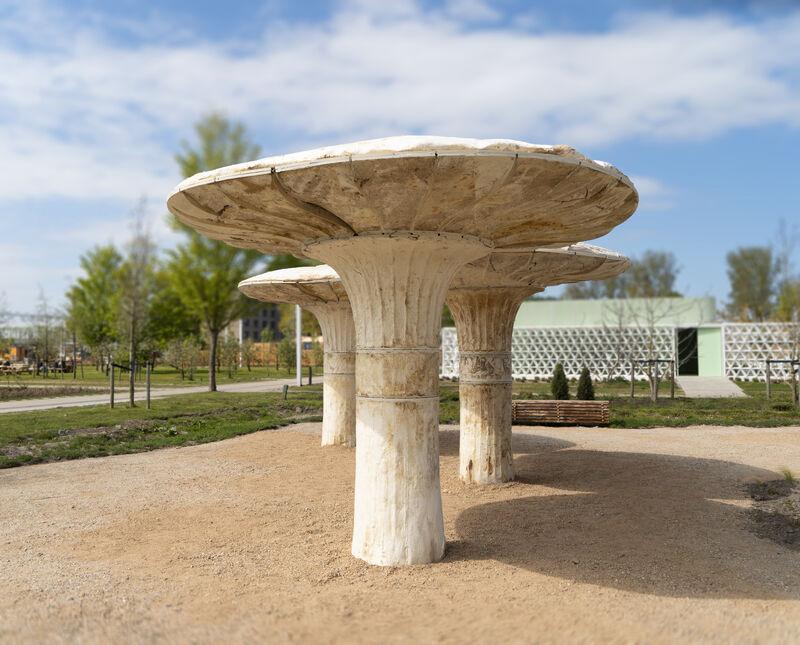
Biobased busshelter
WorldExpo Floriade commisioned us at the Living Lab in Bleiswijk (now in Almere) to develop a biobased bus stop. The biophilic design by Studio Cartier was inspired by mushrooms. The revolutionary and experimental mushrooms of each 3 meters high and wide were constructed with wood, hemp mycelium, and a textile as the skin. The textile decreased the scrapability of the surface, the wood increased the load bearing. Wind load and safety aspects demanded a lot of attention
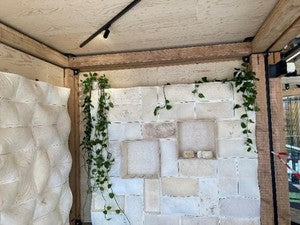
Mymo building blocks
Another product development with Studio Cartier were osteomorphic building blocks. A special filling technique was developed to produce the blocks efficiently. The prototypes were made in the Living Lab, the 100 pieces for the Floriade World Expo were produced by Grown.bio. The blocks can be turned in different directions and still fit each other. The wooden sides actually serve as a lost mold for the mycelium composite. The blocks were designed in the following sizes:30 x 60 cm, 30 x 120 en 60 x 60.
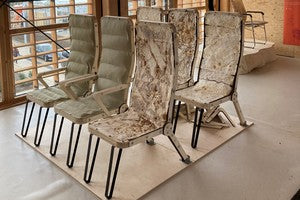
Growing airplanes
Growing airplanes was the two year program supported
by Rabobank, Airbus and Ministry of Infrastructure to develop new materials, like carbon fiber colted plates fully grown with mycelium. Some of the results were shown at Floriade World Expo, like the mycelium airplane seats with a combination of wood, pregrown mycelium textile, and mycelium composite.
